
Home
Restricted Access
Command Structure
Resources
Kill Shots
Screen Shots
Medals Index
Propoganda
Message Board
Secure
Msg Board
Historical Facts
Glossery
Enlistment
Links



Vote For Us
Resource Tactics
Panzer Tactical Manual
Written by Spin005
|
|
|
Chapter 8: Assaulting
| Assaulting |
|
| You must lead with
strength. At least two tanks must be forward, and the trail platoons must be held far
enough forward to support the lead platoon. The more guns that fire in the first minute,
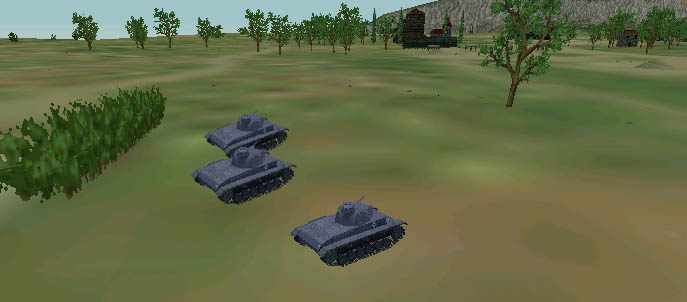
the quicker the enemy will be defeated and the fewer losses you will suffer When breaking cover, do it quickly and together. The more targets the enemy is shown simultaneously, the harder his fire control and distribution will be, and the more guns you will have in effect on the enemy. In the attack drive as fast as you can. At slow speed you can see and shoot only a little better than at high, and are much more likely to be hit. For a tank there should be only two speeds: the half (for firing!) and all out forward. This is the basic principal of tank combat! You must continually keep a broad interval between vehicles. This splits the enemy's defensive fire and complicates his fire control. Narrow intervals must be avoided at all costs, especially in critical situations, or it will cost you losses. When an impassable obstacle, for instance a minefield or antitank ditch, is encountered you must immediately and without hesitation give the order to withdraw into the nearest cover. Standing still, in open sight, trying to carry on the attack, has in such circumstances no sense and will only cost you losses. Your consideration on how to make a new start will be best made in the safety of cover. When your attack must pass potential enemy tank positions, for instance a woodline, you should either pass by them so closely that you are inside their minimum range, or remain so far away that you are outside their maximum effective range Enemy tanks should not be attacked directly, because then they see you and know your strength before you can kill them. More often, you should avoid them until you can move into favorable firing positions, and surprise them from the flank or rear. Repelled enemy tank assaults must be aggressively pursued. Never split your combat power; that is to say, do not employ parts of the company in such a manner that they cannot support each other. When your attack has two objectives you should attack first one and then the other with all weapons. In this way you will more certainly end up with both objectives in hand and fewer casualties. Other weapons and arms, cross-attached to you, should not be misused. Do not use them for purposes for which they were not intended, for example, do not use tank destroyers as assault guns, or armored infantry as tanks, or recon or engineer troops as infantry. Unarmored or lightly armored units attached to you must be protected from any unnecessary losses until they are needed for their own operational tasks, for which reason they were attached to you. You and your soldiers must always concentrate on your combat mission, i.e. "the bridge," and you may not turn aside, for example, to an enemy on your flank, unless he is actually dangerous to the accomplishment of your mission. Then you must attack and destroy him. After a victorious battle; i.e. the seizure of a bridge or the occupation of a village, keep your helmets on. That is to say, prepare for a counterattack which will certainly come, perhaps in a different place than you expect. Later you can collect the spoils of victory. Against strong enemy resistance, there is no point in continuing to attack. Every failed attack only costs more casualties. Your effort must always be to hold the enemy with only weak forces, in order to use mass of your strength at another, weaker place, breakthrough, and destroy the enemy by surprise attack in the rear or flank Never forget that your soldiers do not belong to you, but to Germany. Personal glory hunting and senseless dare-deviltry lead only to exceptional cases to success, but always cost blood. In battle against the Soviet- Russians you must temper your courage with your judgement, your cunning, your instincts and your tactical ability. Only then will you have the prerequisites to be victorious in battle and only then will your soldiers look on you with loyalty and respect and always stand by you in untiring combat readiness The panzer division in modern warfare today holds the former place of cavalry as the decisive arm of combat. Tank officers must carry on in the tradition of the cavalry, take up its aggressive spirit on behalf of the Panzer arm. |
|
|
|
